Rewiring Georgian townhouses and listed homes in Bath with concealed routes, minimal chasing and accessories that suit the room, plus a clear written scheme for listed building consent.
Quick enquiry
Tell us whether the building is listed and roughly what you are planning. We come back within 24 hours.
The whole city of Bath has been a World Heritage Site since 1987, and its listed buildings run from the Grade I crescents to ordinary terraces of Bath stone. None of these houses was built with electricity. Most were wired in the twentieth century, some more carefully than others, and many now carry a patchwork of old and new circuits behind historic plaster.
A heritage rewire is about where the cables go as much as what they are. The aim is a modern, safe, fully tested installation that leaves cornices, shutters, panelling and lath-and-plaster ceilings as they were. That takes more planning time and less cutting, and it is how we price and programme these jobs.

Listed building consent is required for works that alter a listed building in a way that affects its character, and that applies inside as well as out. Lifting historic boards, chasing original plaster, fixing to panelling, or replacing fittings that contribute to a room's character can all fall within it. Doing that work without consent where it is needed is a criminal offence.
The consent application is the owner's (or their architect's) to make. Our part is to make it straightforward. We survey, propose routes that use existing voids and previous cable paths, and set out fixing methods and accessory finishes so the conservation officer can see exactly what will and will not be touched.
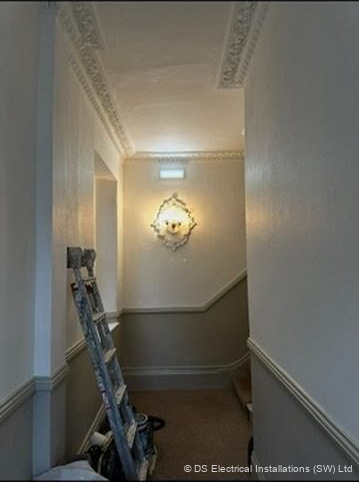
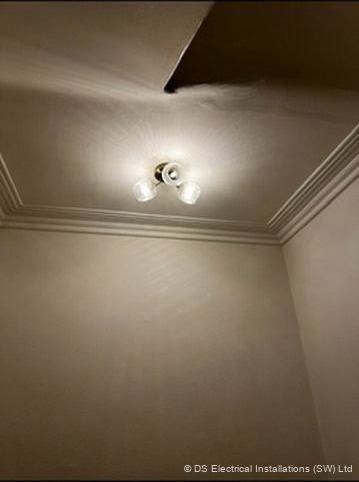
No two listed houses are the same, so we don't publish a price list. The price depends on the size of the property, how it is built, the cable routes the fabric allows and how much of the wiring can stay. An EICR first shows which circuits are sound. We survey, then give you a fixed written quote.
For general rewires of unlisted Bath homes, see our rewires in Bath page. For lighting and wider heritage electrical work, including churches and commercial buildings, see heritage electrical work in Bath.
Often, yes. Listed building consent is needed for alterations that affect the character of a listed building, and that includes internal work such as chasing historic plaster or moving fittings. Carrying out work that needed consent without it is a criminal offence, so the question is settled with Bath and North East Somerset Council before work starts. We help by preparing a clear scheme: proposed cable routes, fixing methods and accessory details.
Most of the time. We reuse existing routes and service voids, lift original floorboards carefully and put them back like for like, run cables behind skirting and architrave lines, and use the shallowest neat surface fixing where nothing else works. Where a chase is unavoidable, it is only done with consent and filled with a lime-compatible base coat.
Only if you want them to. Our default range is Click Deco and Deco Plus screwless plates in chrome, brass, antique brass or brushed steel. For period rooms we also fit traditional-style brass and bronze accessories, and we will agree finishes room by room before ordering.
Every listed job is quoted per property after a survey, because the price depends far more on cable routes and the fabric of the building than on bedroom count. A listed flat in a converted townhouse is priced the same way, once we have seen it.
Yes. We work from the architect's drawings where there are some, and produce our own route plan and specification where there are not, so the conservation officer can see exactly what is proposed.
A written, itemised quote before any work starts. NAPIT registered, BS 7671 certified.
07889 334849