Our recent EICRs in Shepton Mallet have included landlords on the five-year cycle, in Victorian stone terraces, Georgian townhouses on Town Street and Edwardian semis. We inspect and test every circuit, hand you a coded report you can pass straight to tenants or an agent, and price any remedials in writing so the 28-day deadline is easy to plan for.
The Electrical Safety Standards in the Private Rented Sector and Social Rented Sector (England) Regulations 2020 set out a short list of duties. In practice they come down to this:
Those 28-day windows are the reason we price remedials as soon as the report is written, instead of leaving you to chase a second quote.
This year we carried out two EICRs in the town that show how differently the same kind of visit can end.
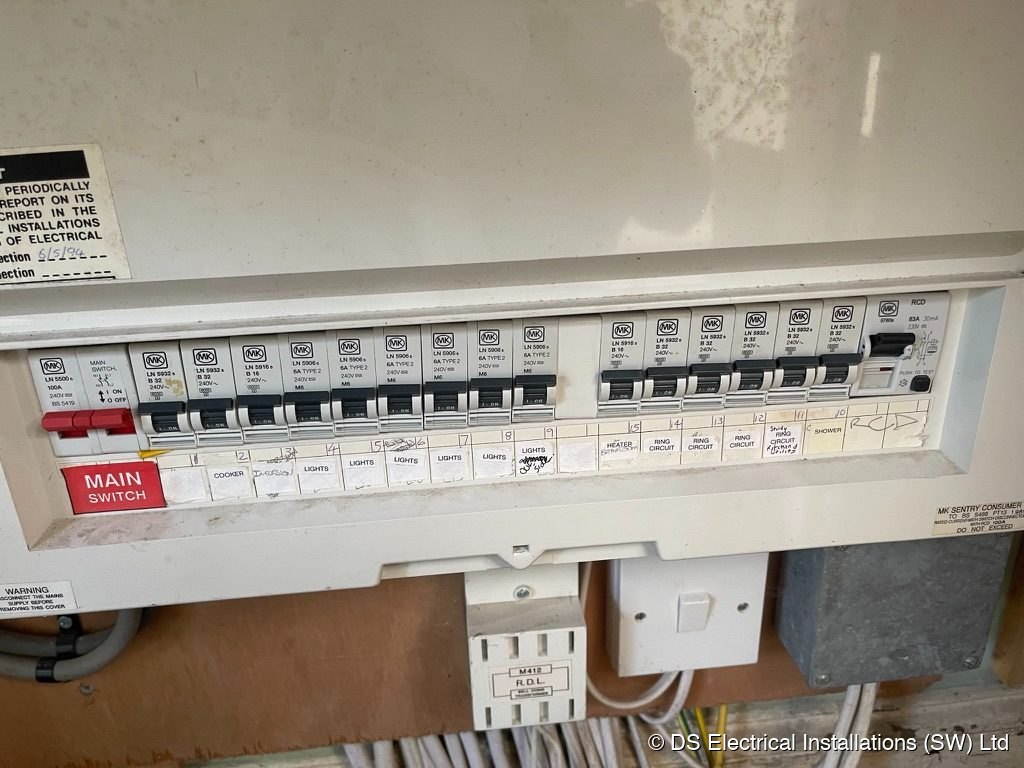
A five-year landlord EICR on a three-storey house with nine circuits and a supply out to a garage. The circuits had no RCD protection. That is a C2, and on its own it makes the report unsatisfactory. Four further items were coded C3, which are improvements and do not fail a report. As with every unsatisfactory result, a written price for the remedial work goes with the report, so the 28-day period can be planned from the start.
The second property passed, with an overall assessment of satisfactory.
The one item that failed the first house was the missing RCD protection, and a board with a Type A RCBO on every circuit deals with exactly that.
We quote each job on its own merits. An EICR is priced on the size of the installation and the number of circuits, and a landlord pack on what the property needs in alarms and certification. Landlords with several lets can ask us to quote the portfolio together. Remedial work is priced separately, in writing, from the findings on the report.
Older houses in Shepton Mallet sometimes still carry the remains of an Economy 7 arrangement: two consumer units side by side, a bolt-on RCD box added later, and a tangle of tails between them. Set-ups like that are awkward to test and easy to misread when you are trying to isolate one circuit.
At one house in town this year we consolidated two old consumer units and a bolt-on RCD box into a single metal RCBO board with surge protection, on a single supply in place of the old off-peak split, fitted new 25mm² meter tails and finished with a full EICR. If your report flags the board, our consumer unit replacement page for Shepton Mallet explains what we fit: a main switch and a Type A RCBO on every circuit, so a fault only switches off its own circuit.
Most of the delay in a rental inspection is arranging access, not the testing. A few things make it simpler:
You receive the report ready to pass to tenants inside the 28 days. More on the wider duty is on our landlord compliance page for Shepton Mallet.
Alongside the inspections above, a few more examples from the town this year, with no names or addresses.
For owner-occupiers there is no legal interval. Roughly every ten years is the common guidance, plus a test when you buy or sell. In the stone terraces around the centre and the Edwardian semis further out, an inspection is particularly worthwhile if kitchens, showers or loft rooms have been added over the years, because every addition is a point where an older circuit may have been stretched beyond what it was designed for.
A typical three-bed semi takes 2.5 to 3 hours on site. Each circuit is checked for continuity, insulation resistance, polarity, earth fault loop impedance and RCD operation, and the readings are written onto the schedule so you can see the work was done.
Leave your details and a line about the job. We will ring you back to talk it through and arrange a survey or a written price.
At intervals of no more than five years under the 2020 regulations, or sooner if the previous report says so. A report can set a shorter interval where an installation is older or in poorer condition, so check the recommended date on your current one. A new tenant must be given a copy of the current report before they move in.
Yes. If an agent holds the keys and handles tenant contact, put us in touch and we will arrange the visit with them. The report comes to you and, if you want, to the agent as well. Any remedial price comes to you for approval before work starts, because you are the one responsible under the regulations.
Usually that is the simplest fix. Bolting RCD protection onto an old board piecemeal rarely makes sense, and a metal board with a Type A RCBO on every circuit means a fault on one circuit only switches off that circuit. The new board includes surge protection and AFDD on bedroom sockets, and is priced in writing before we start. We re-test afterwards and issue updated certification.
No. The EICR covers the fixed electrical installation. Smoke and carbon monoxide alarms are a separate legal duty for landlords: a smoke alarm on each storey with living accommodation, and a CO alarm in any room used as living accommodation with a fixed combustion appliance other than a gas cooker. Our single-let pack covers both in one visit.
Remedial work puts right something the report has coded C1 or C2. Further investigative work, coded FI, is needed when we have seen signs of a problem but cannot confirm its cause or extent without more time or access. Under the 2020 regulations both have to be done within 28 days, or sooner if the report says so, and the landlord confirms completion in writing to the tenant and the local housing authority.
Priced by the job, not by the hour. A written, fixed price after a survey, NAPIT certification on every notifiable job.
07889 334849